
This post is grounded in two working Voice AI demos our expert AI integrations team built to explore how authority, execution, and human-in-the-loop control actually behave in production. If you are automating customer support in a regulated industry (fintech, healthtech, insurance, telecom, education), the hardest part is not latency or naturalness, it’s authority. Deploying Voice AI in fintech, healthcare, insurance, telecom, education, or any regulated industry, requires a production system that enforces strict execution control. Specifically:
- Who is allowed to say what
- Who is allowed to do what
- Under which conditions
- When systems are slow, wrong, or partially failing
Voice AI prototypes avoid these questions. Production systems cannot.
The Core Question for Production Voice AI: What Happens When the Model Is Wrong?
Once a voice agent can:
- access customer data,
- change ticket state,
- escalate to a human,
- trigger workflows,
- or interact with regulated systems,
you are forced to answer a simple but uncomfortable question: What prevents the system from doing the wrong thing when the model is wrong? A common failure looks like this: the user asks for an update and the agent executes an escalation path. Nothing is “wrong” in isolation but the call is already transferred when it wasn’t required or allowed. There is no undo. In regulated environments, these failures are not bugs, they are liability events.
Why Most Voice AI Architectures Fail in Regulated Environments
Most Voice AI stacks collapse three concerns into one place:
- Conversation handling
- Reasoning
- Execution
Typically, the agent owns all three. This works until:
- intent is misclassified,
- a new tool is added,
- a shortcut is introduced during iteration,
- or a dependency behaves differently under load.
At that point, the model implicitly gains execution authority. That is the root failure mode.
The Critical Architectural Boundary: Execution Control in Voice AI
The key distinction is not voice vs text, or one LLM vs another. It is this: Can a real action execute unless the platform explicitly allows it? If the answer is “yes, unless guarded,” the system is fragile. If the answer is “no, unless routed,” the system is controllable.
A Production-Ready Voice AI Architecture for Regulated Industries
Production Voice AI needs explicit separation of responsibility. Real-time agent frameworks handle voice and telephony concerns, a stateless text-first reasoning layer interprets intent without execution authority, and a controlled execution layer performs real actions only when explicitly allowed.
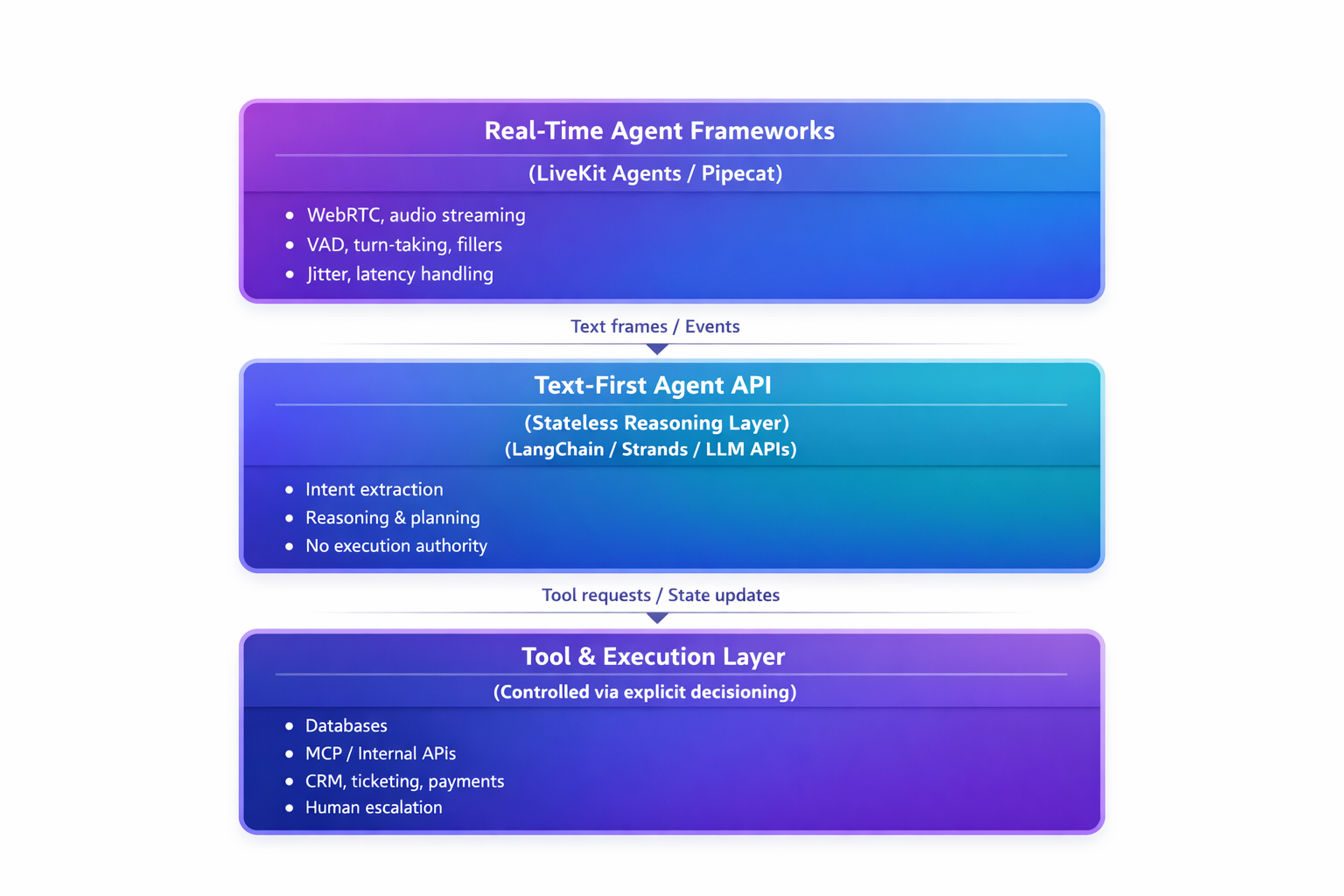
Layered Voice AI Architecture for Regulated Environments.
A Concrete Failure Scenario
User says: “Why is my case still open?” The model misclassifies intent as “escalate”.
- In an agent-centric system, escalation may occur unless every guard is perfect.
- In an execution-graph system, escalation is impossible unless policy explicitly routes there.
Same model. Same voice stack. Completely different risk profile.
Voice AI Stability and Failover in Production Environments
Production Voice AI degrades differently in every environment:
- SIP carriers behave differently
- Network paths fluctuate
- STT, LLM, and TTS providers introduce variable latency
- Partial failures are common
In real deployments, a 300 ms delay is noticeable, a 2 second delay breaks turn-taking, and anything beyond that often results in interruption or call abandonment. If reasoning and execution are tightly coupled, failures cascade. If execution is gated we achieve failure containment:
- the system can deny safely,
- degrade gracefully,
- and never “do something just because the model tried.”
Why Rule Engines Alone Can’t Solve Voice AI Execution Control
Traditional rule engines are deterministic and auditable, but they are fundamentally limited: they are stateless, synchronous, unaware of conversational flow, and unable to coordinate voice turns or human handoff. Conversely, real-time voice agent frameworks like LiveKit Agents or Pipecat excel at conversation management—audio timing, interruptions, and turn-taking—but are unsafe by default when it comes to execution. While these frameworks provide workflow primitives (e.g., LiveKit Agent Workflows or Pipecat flows), execution control is not their primary design goal. Production systems benefit from combining both approaches. Real-time agent frameworks own conversation and media, while rule engines or execution graphs own authority and side effects. This separation of concerns makes responsibility explicit and prevents execution logic from leaking into model-driven conversational code.
Two Voice AI Demos: Decision Engines vs. Execution Graphs
To make these trade-offs tangible, we built two small demos that intentionally explore different ways of keeping decision authority outside the model while supporting human-in-the-loop flows. The first is a fintech-oriented Voice AI demo using Twilio, Pipecat and decisionrules.io, a third-party decision system. View the GitHub repo here. See how it captures basic applicant info over a phone call, simulates credit scoring, applies decision rules, and can escalate to a human for review in the video below.
The second is a customer support demo built with open-source components using LangGraph. View the GitHub repository here. In this scenario, decisioning is implemented as an explicit execution graph: actions are unreachable by default and only become possible when policy routes execution to them. This removes reliance on third-party decision platforms while preserving strict control over escalation and side effects. (Another blog post and video demo to follow!) Both demos enforce the same principle: human-in-the-loop control and decision authority live outside the model. The difference is where that control resides: an external decision engine versus an explicit execution graph.
What Production-Grade Voice AI Actually Requires
Production Voice AI does not mean:
- better prompts,
- nicer voices,
- more tools.
It means:
- unsafe actions are structurally impossible,
- failures degrade safely,
- execution paths are auditable,
- behavior remains correct under partial failure.
A useful test: if an AI agent could accidentally transfer a live call for any user at any time, the system does not yet have an execution boundary.
The Bottom Line
Once Voice AI touches real systems, the problem shifts: The hardest part is not what the model can say. It’s what the system is allowed to do when it is wrong. Separate voice. Separate reasoning. Gate execution. That is how Voice AI becomes infrastructure instead of a liability.
Need Help Building Production Voice AI?
If you’re exploring Voice AI for a regulated environment and need architecture that goes beyond the prototype, AgilityFeat’s nearshore team specializes in AI integration for production systems, with a special focus on regulated industries. We help fintech, healthcare, and enterprise teams design voice AI solutions with proper execution control, compliance-aware architecture, and human-in-the-loop workflows that actually work under load. Ready to move from prototype to production? Learn more about our LLM integration services or contact us to discuss your specific use case.