
Client: Worksource (AI Startup Concept) | Industry: HR Technology | Project Type: Hybrid AI Proof of Concept | Timeline: 2 weeks
“Working with [the AgilityFeat team] was great. It is amazing to tell someone the idea you have in your head and how you want it to behave and see that brought to life. They move fast and produce a quality product.” – Caitie Puma, Worksource Founder
Early-stage founders rarely have the luxury of months-long experiments or open-ended R&D. They need fast, concrete proof that AI can do something meaningfully different for their users, and they need it in a form investors can understand.
This hybrid AI POC case study documents how AgilityFeat’s nearshore development team helped an early-stage AI startup concept validate a verified hiring platform in two weeks. The proof of concept uses AI where it delivers the most value: parsing unstructured resumes into structured profiles, while relying on a rules-based matching engine and integration-ready design for third-party verification.
The result gave the founder a concrete way to test the concept, prove where AI is a good fit (and where it is not), de-risk full product development, and a demo ready for investors.
The Problem: AI Broke Trust-Based Hiring
Traditional job platforms operate on trust. Platforms like LinkedIn, Indeed, and ZipRecruiter provide no identity verification or work history validation. In an AI-enabled world, this model is failing.
Job seekers can generate convincing resumes in seconds using AI tools. Employers receive hundreds of applications with inflated credentials, fabricated work history, or entirely AI-generated content. The result:
- Real candidates get lost in noise
- Employers waste time filtering fake applications
- Neither side trusts the process
The Startup Concept: Fixing Trust in Hiring
The Worksource idea was born from a painful reality on both sides of the hiring market.
As a job seeker, the founder spent months applying full-time, sending over 1,000 resumes, and getting only two callbacks. She had no connections, no local credibility having just moved to a new town, and no way to stand out in a sea of similar-looking applications. Later, working in HR, she saw the mirror problem: employers drowning in applicants whose resumes were mostly unverified and sometimes fabricated.
Her concept for Worksource is a verified hiring ecosystem where:
- Job seekers can prove their credentials are real.
- Employers see structured, trustworthy candidate profiles.
- Fraud, scams, and fake or AI-written resumes are pushed to the margins, not the center.
To move from idea to product, she needed a fast, targeted experiment, not a full build. The question: can we combine AI, rules, and integrations into a hiring flow that filters noise and controls the signal?
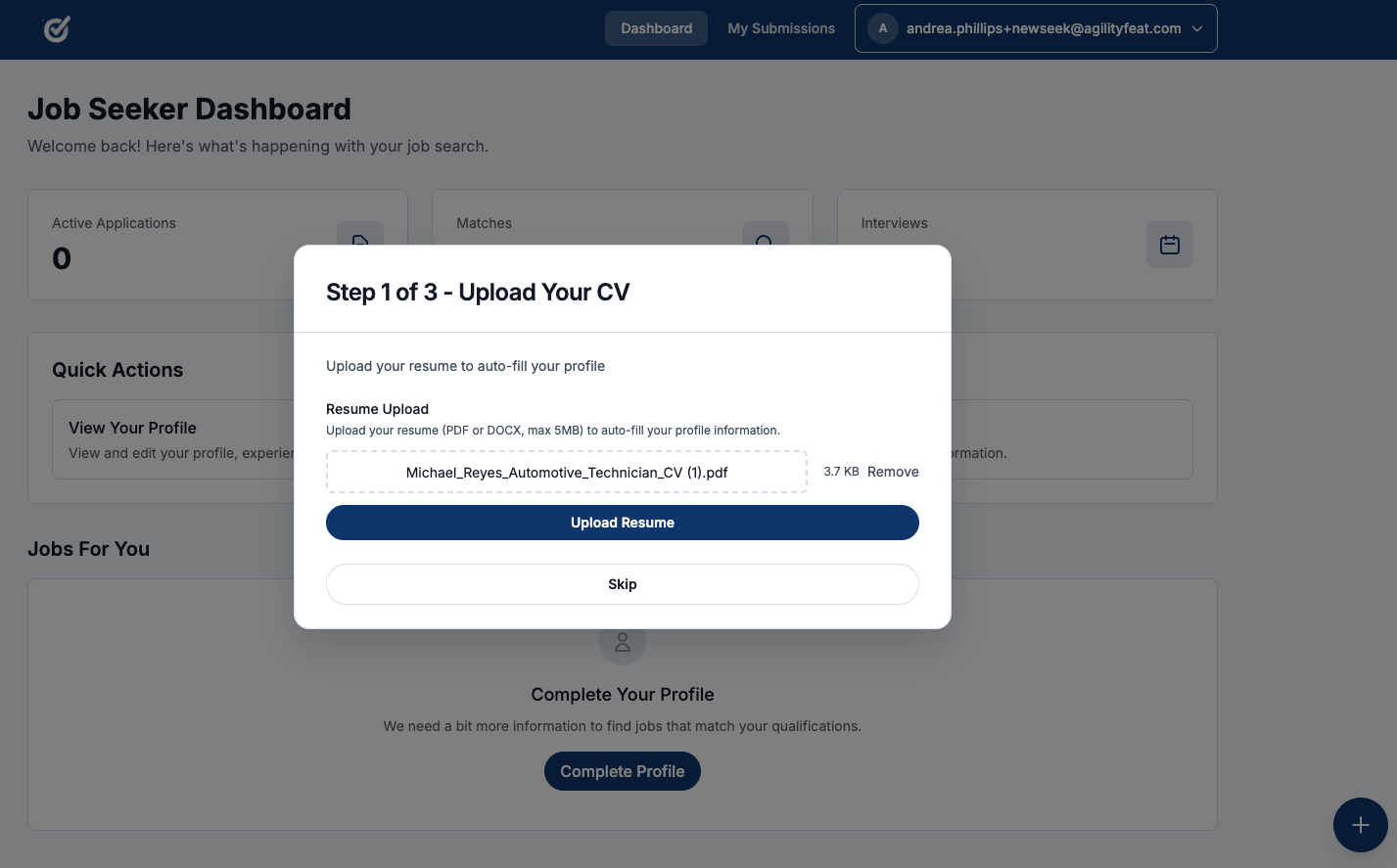
Job Seeker Dashboard: Resumes are messy and inconsistent. AI excels at extracting entities, normalizing titles, and pulling out skills and dates.
Our Approach: Hybrid AI POC Strategy
When the founder first approached us, the vision was to make AI the engine behind almost every part of the platform, from resume parsing to verification to matching. In discovery, we worked together to separate what sounded exciting from what was actually practical.
The outcome was a hybrid design that uses AI strategically, not everywhere.
Where AI Delivers Clear Value
- Unstructured → structured transformation. Resumes are messy and inconsistent. AI excels at extracting entities, normalizing titles, and pulling out skills and dates.
- Assisted profile creation. AI can remove the tedious parts of data entry while still letting users remain in control of their information.
Where Rules and Integrations Work Better
- Core matching logic. Worksource doesn’t use AI to decide who qualifies. Instead, it uses explicit, transparent rules. Ten hard gates (job title, industry, work authorization, work arrangement, employment type, location, experience, education, required certifications, required skills) determine whether a job is visible to a candidate. If any gate fails, the job simply doesn’t appear.
- Ranking and prioritization. Jobs that pass the gates are scored using a clear, 100-point model that considers preferred skills, certifications, compensation overlap, and other “nice to have” factors. Every point can be traced back to a rule, not a black-box model.
- Verification. Identity verification and deep work-history validation are critical to the Worksource vision, but all the heavy lifting does not need to be done with a homegrown AI model. Instead, the architecture readies those capabilities to be provided by specialized third-party services.
This separation of concerns matters for trust and explainability. AI handles interpretation; rules handle decisions. For an early-stage startup, that makes it easier to iterate, debug, and explain to investors exactly how the system works.
Smart Integration Design
The POC’s job is to:
- Capture structured data from resumes in a way that’s easy to send to verification providers.
- Surface anomalies (like overlapping timelines or suspicious patterns) so humans know where to focus.
- Keep the core platform modular enough to plug in verification APIs later without major rework.
This is what smart integration design looks like in a POC:
- You don’t rebuild what the ecosystem already does well.
- You make sure your data model and workflows are ready to connect to those services.
- You focus your engineering effort on the parts that make your product unique, like parameter-based visibility and candidate experience.
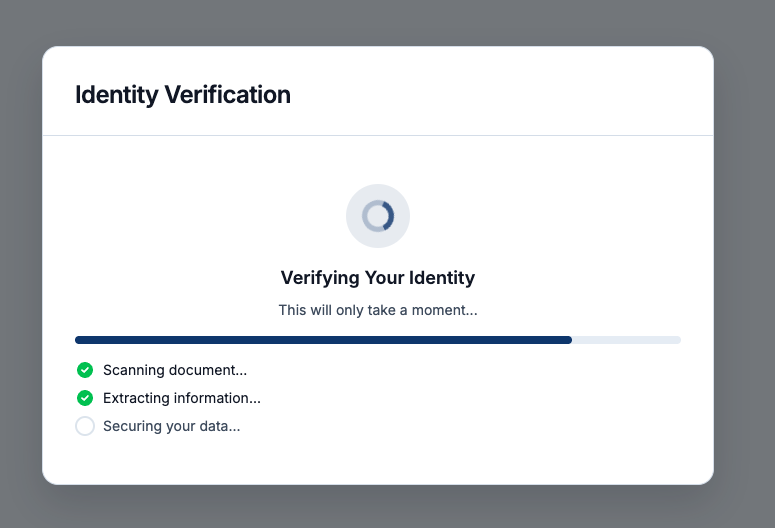
Smart Integration: The architecture readies those capabilities to be provided by specialized third-party services.
Implementation: From Resume Upload to Structured Profile
The first part of the POC focused on reducing friction for candidates while improving data quality for the platform. Instead of asking users to fill out endless forms, Worksource uses AI to jump-start their profile.
- Single upload. Candidates upload a resume once.
- AI extraction. An LLM reads the resume and pulls out fields like job title, experience level, education, skills, and certifications.
- Structured mapping. Only data that fits the platform’s defined parameters is persisted; unmapped items trigger a warning and are excluded.
- Human in the Loop. Candidates review the AI-generated profile, correct any mistakes, and add missing details before saving.
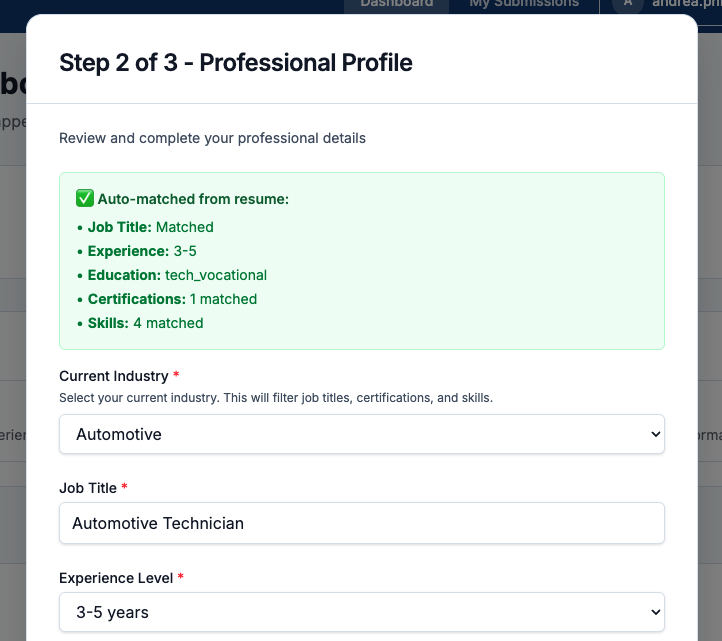
Human-in-the-loop (HITL) keeps the AI powerful but accountable: the system surfaces structured insights and potential issues, while humans make the final call on what is true, complete, and fair.
For founders, this is what fast concept prototyping looks like: in two weeks, you can move from “What if we used AI to build profiles?” to “Here is a working flow that parses real resumes into queryable, structured data.”
Human-in-the-loop (HITL) keeps the AI powerful but accountable: the system surfaces structured insights and potential issues, while humans make the final call on what is true, complete, and fair. Candidates review and correct AI-generated profiles, and suspicious items are flagged, not silently rejected.
Why This AI POC Model Works for Early-Stage Startups
This AI POC model works because it compresses validation into a short, focused sprint: one high-value workflow, an end-to-end experience, and a visible outcome that ties AI directly to product differentiation.
Prove Core Value, Not the Entire Vision
A fully verified hiring ecosystem would be far too ambitious and costly at this stage. The AI POC stays laser-focused on the foundation: identity and work-history validation from a resume upload, plus job matching driven by those verified profiles. That focus allowed the team to:
- Demonstrate concrete before/after: from untrusted PDF to structured, verification-aware profile
- Validate that AI can drive real product differentiation, not just summarization
Design for Future Evolution
Although the AI POC focused on verification and matching, the structured data naturally supports future capabilities:
- Matching candidates to roles based on verified skills instead of keyword stuffing
- Detecting fraud patterns across the ecosystem
- Providing employers with filterable signals like “verified work history” or “no anomalies detected”
A Reusable Pattern for AI Startups
This engagement wasn’t just about Worksource; it’s a reusable pattern for many early-stage AI concepts.
- Fast concept prototyping. Focus on one end-to-end journey—resume upload to job visibility—and build a working version in weeks.
- Right-sized AI. Use AI where it offers clear leverage (interpreting unstructured inputs), and rely on rules and human review where clarity and control matter.
- Integration-ready design. Treat third-party services (identity, fraud, verification) as first-class citizens in your architecture, not afterthoughts.
For founders, this kind of hybrid AI POC doesn’t just answer “Can we use AI?” It answers a more important question: “Where should AI live in our product, how does it cooperate with rules and humans, and can we prove that in two weeks?”
Why Nearshore Development Accelerates AI POCs
To validate the AI verified hiring concept, the founder partnered with AgilityFeat’s nearshore development team to turn her AI startup ideas into a working proof of concept. This model is particularly valuable for early-stage startups that need to show traction quickly.
A nearshore team provides:
- Aligned time zones with North American founders, supporting tight feedback loops during short AI POC cycles
- Hands-on experience integrating AI and LLMs into real products, not just demos
- POC designs that can evolve into production systems instead of throwaway prototypes
For the Worksource AI startup, that translated into a two-week AI implementation that showed how AI verified hiring would work in practice.
AI POC Takeaways for Early-Stage Founders
If you’re exploring an AI startup idea, whether in hiring, identity verification, fraud detection, or another trust-sensitive domain, this AI POC pattern offers a pragmatic path forward:
- Start with one high-value workflow that proves your core hypothesis
- Use AI to transform messy, unstructured inputs into structured data you can verify and act on
- Build verification and anomaly detection into the core flow, not as an afterthought
- Keep humans in the loop so your AI remains explainable, auditable, and trustworthy
- Partner with an experienced nearshore team to move from AI startup idea to working AI proof of concept in weeks, not months
For early-stage AI startups, a well-designed AI POC validates your vision, de-risks your roadmap, and shows investors that your concept can become a real, defensible product.
Need Help Validating Your AI Startup Idea?
At AgilityFeat, we specialize in rapid AI POC development for early-stage startups. Our nearshore software development teams in Latin America combine deep expertise in AI/LLM integration with startup-focused agile methodologies to help you validate product concepts in weeks, not months.
Whether you’re building AI verification systems, intelligent matching platforms, fraud detection tools, or any other AI-powered application, our teams can help you move from concept to working AI proof of concept that demonstrates viability to investors and stakeholders.
Why early-stage AI startups choose AgilityFeat
- Expertise You Can Trust. Over a decade of experience delivering advanced software and AI solutions for US clients.
- Flexible Collaboration. We assemble the right technical team for your needs, working as an extension of your in-house staff.
- Global Perspective, Local Execution. US-based company with deep roots and operational support in Latin America.
Ready to validate your AI startup idea? Schedule a free consultation to explore how our nearshore team can help bring your vision to reality.
Further Reading:
-
Building Investable AI Startups: The Value of Nearshore Development Partners
- AI Video Editor Development: Building Verbolo’s Intelligent Content Creation Platform
- When Does a Serverless MVP Approach Work Best?
- Five Tips for Integrating LLMs into Software Products
- How to Hire LLM Engineers: Why Latin America Solves the AI Talent Crisis