
When the conversation turns to AI, the lens almost always points westward. To San Francisco, Palo Alto, or to the handful of hyperscalers dominating the headlines. It’s an understandable bias. But it’s also an increasingly expensive one.
Over the course of a week in Mexico City, I sat down with engineers, founders, researchers, and business leaders who are building real AI-driven applications, scaling technical teams, and producing original AI research … all outside the Silicon Valley spotlight. The conversations I had on AI Engineering in Mexico for the Scaling Tech Podcast challenged some assumptions that are deeply embedded in our industry. If your company’s talent strategy still thinks of Mexico and Latin America only as a lower-cost execution layer, it’s time to update your mental model.
AI Adoption Is Accelerating Everywhere
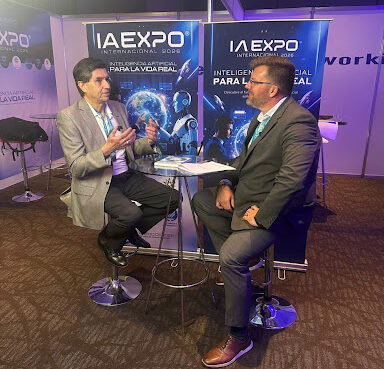
Dr. Eduardo Perez, founder of the IA Expo in Mexico City, put it plainly: “[AI] adoption is still in its infancy. It’s less than 20%. My feeling is that it’s going to go to 80, 90, and 100% in a few years.” He offered this urgent note to anyone still sitting on the fence:
If you have an [AI implementation] idea and you don’t implement it in a few days or a month, you’re already behind.
That urgency is palpable throughout Latin America’s technology ecosystem right now. Companies across industries, from civil infrastructure to healthcare to financial services, are embedding AI into their core operations. The window to build teams and capabilities that can capitalize on this wave is open today. It won’t stay open forever.
Production-Grade AI Engineering in Mexico City
One of the most important takeaways from my week in Mexico City was just how applied and ambitious the AI work being done there truly is.
- In public infrastructure, Dr. Gabriel Barrera Delgadillo and his team at Cal y Mayor are using AI to analyze 23 terabytes of documentation on the Tren Maya, a major rail project spanning the Yucatan peninsula. A project of that scale requires not just engineering talent, but the kind of systems thinking and AI integration expertise that can be hard to find anywhere.
- In healthcare, Dr. Carlo Angello, a resident doctor in vascular surgery in Mexico City, told me how AI is beginning to reduce physician burnout by automating documentation and report preparation. Tasks that once took two hours now take ten to fifteen minutes. As he put it: “AI is not to replace us, it’s to augment us.”
- In AI research itself, Alberto Alejandro Duarte and his team at Paradox Systems (based in Baja California Sur) are developing a novel approach to LLM safety: a context filtering layer that applies principles from biological persistence to reduce hallucination rates. Their early testing results are promising, and their work is a reminder that AI research innovation is not the exclusive domain of US research labs.
- In talent technology, companies like huntRED and Codifin are building sophisticated AI-powered platforms in Mexico, using Mexican engineering talent, to solve real enterprise problems. Pablo Lelo, Senior Managing Director at Grupo huntRED, told me about their platform Aurora, which runs 16 servers, analyzes over 800 dimensions of candidate data, and currently models over a million professionals. Pablo Fajer, Founder of Codifin, built an AI recruiter named Cody in-house. Cody started at 42% accuracy and has been refined to 92%: a testament to the iterative engineering discipline of his Mexican-based team.
This isn’t theoretical AI capability. This is production-grade AI engineering happening in Latin America.
Mexico’s Nearshore AI Talent Argument Has Evolved
The traditional case for nearshoring was straightforward. Quality engineering talent at a more sustainable cost, in a time zone that enables real-time collaboration with North American teams. That case is still valid. But what I heard in Mexico City suggests the talent story has become more compelling, not less.
Pablo Fajer from Codifin described a broader trend he’s observing across his clients. Companies are increasingly moving toward in-house engineering teams because they want to own their technology. And to build those teams affordably without sacrificing quality, they are looking to Mexico. As he explained, they’re not looking for junior talent. They want senior engineers who understand AI and can use it to build stronger, more valuable products.
The catch? The talent pool requires navigation. Mexico has roughly a million developers, but what Pablo calls “GCC talent” represents only about 20–25% of that total. GCC talent refers to those who are equipped to work in Global Capability Centers (GCCs), which means they need to be bilingual, professionally polished engineers with the technical depth for enterprise-grade AI work. That’s still a large and valuable pool, but it’s one that rewards having the right partners to help you find, vet, and engage the right people.
Andrés del Cos from EscalaMiNegocio framed the broader talent reality well:
Everybody’s ready for AI. They’re just at different stages of implementing it.
That statement applies as much to individual engineers as it does to companies adopting AI technologies. Latin America has a growing population of engineers who are actively upskilling in AI tooling, LLM integration, prompt engineering, and agentic systems development. The developers Pablo Fajer is seeing in demand are no longer just coders. Instead, he says “they’re becoming more architects and they’re becoming more data-led developers.”
Why Ignoring AI Engineering in Latin America Costs You
There is a practical consequence to the AI talent conversation being so Silicon Valley-centric: it makes good talent harder to find and more expensive to hire, while large pools of high-quality engineering talent in Latin America go underutilized.
The engineers building infrastructure AI, healthcare AI, LLM safety systems, and AI-powered recruitment platforms in Mexico are not junior practitioners waiting to be discovered. They are professionals solving hard problems with real constraints. Many of them are bilingual, many have trained at top universities, and many are deeply motivated by the problems they’re working on.
There’s also a practical advantage in the cultural and linguistic diversity of Latin American AI talent. As I explored in my conversations for the podcast, AI applications built primarily around English-language models have real limitations in Spanish-speaking markets. Companies like Celestial Dynamics in Mexico City are building LLMs specifically calibrated to Mexican Spanish. Not as a curiosity, but because generic LLMs fail in subtle and important ways when they don’t account for regional linguistic variation. If your company is building AI products for global or multilingual markets, having engineers who understand those markets is a genuine competitive advantage, not an afterthought.
Building Your AI Engineering Team in Latin America
If you’re an engineering leader thinking about how to staff your AI initiatives, the practical question isn’t whether Latin America is worth considering. It’s how to build there effectively.
There are a few different models that work well depending on your goals:
- Staff Augmentation is a great starting point if you want to move quickly and embed experienced AI engineers into your existing team without the overhead of establishing a new entity. This works particularly well for companies that already have a defined tech stack and need to add capacity and AI-specific expertise quickly.
- The Build-Operate-Transfer model is worth exploring if your longer-term vision is to own a full engineering capability center in Latin America. You get the benefit of an experienced partner managing the ramp-up, the legal and compliance complexity, and the talent recruitment along with a clear path to full ownership once the operation is mature. The regulatory processes in Mexico (and throughout Latin America) are more complicated than most US companies expect, and working with someone who has done it before is essential.
- Project-based AI development is the right fit if you have a specific AI prototype or LLM-integrated application you want to build and ship. An experienced team that already knows how to build with the latest AI tools can compress your timeline dramatically while you develop your longer-term hiring strategy.
The View From Mexico City
As Dr. Francisco Javier Novoa, an organizational consultant and agile coach, told me during my week in Mexico City:
Creativity has to find you working and producing… Change has to find you producing, experimenting, questioning, opening yourself to possibilities. The moment you open yourself to possibilities, then new things can arrive.
That spirit was everywhere I went in Mexico City. It was in the surgical residents using Meta Glasses to document operations in real time. It was in the startup founders iterating relentlessly on hallucination rates. It was in the researchers exploring biological principles to make LLMs more reliable.
The AI talent story is not a Silicon Valley story, it’s a global story. And Latin America is one of the most compelling chapters being written right now.
AgilityFeat helps companies build and scale world-class software engineering teams across Latin America, using Staff Augmentation, Build-Operate-Transfer, and project-based models. If you’re ready to build your AI engineering capability in LatAm, contact us today!
Author’s note: Arin Sime is the Founder of AgilityFeat and host of the Scaling Tech Podcast where he interviews engineering leaders about scaling teams and building great products. The Mexico City episode series referenced in this post is available on Spotify, Apple Podcasts, and YouTube. For more details on the guests, see the show notes for the first and second episodes at ScalingTechPod.com
Further Reading:
- How to Hire LLM Engineers: Why Latin America Solves the AI Talent Crisis
- When Is the Right Time to Scale Your Software Development Team?
- Best Practices for AI-Assisted Software Development
- Spec-Driven AI Integration: Automating Complex Workflows with MCP and Agentic Tools
- Proof of Value vs. Proof of Concept in the Age of AI
- 2 Week Hybrid AI POC: Prototyping a Startup Concept with Smart Integrations and the Right Use of AI