
Spec-driven AI tools automate complex workflows by first generating detailed specifications. These are clear, step-by-step plans that humans review before executing them precisely, minimizing errors across industries like software development, fintech, and creative production. Using protocols like Model Context Protocol (MCP) and agentic editors like Kiro, they bridge human intent with AI action.
In this post, we’ll explore a real-world example of automating complex workflows with MCP and agentic tools: streamlining music production with MCP, Kiro, and Reaper DAW for “Por eso te amo (La Cajita del Amor)”
For more on this topic, check out my appearance on the Scaling Tech Podcast Episode 63: Spec-Driven Creativity: AI Collaboration in Music and Software!
AI in Creative Workflows
To begin with, let’s address the ‘elephant in the studio’ right away: AI is not exactly well received in the music industry (or any form of art). It’s a heavy topic. Many artists are understandably worried not just about AI taking over jobs, but about algorithms competing directly against human art, perhaps even with an unfair advantage. Not to mention, the issue with companies training models on their work without proper compensation or permission.
In this workflow, AI doesn’t replace human creativity. It acts as another studio instrument, similar to how synthesizers and drum machines went from controversial to commonplace.
AI can complement human creativity in multiple ways:
- The Reasoning Partner: It acts as a tireless collaborator. You can use AI to bounce ideas around, break through writer’s block, and explore unconventional chord progressions or song structures that you might not have considered.
- The Tedium Terminator: Through Model Context Protocol (MCP) servers, AI can automate the soul-crushing, tedious tasks that drain creative energy. Routing buses, naming tracks, and setting up sidechains can happen instantly, allowing artists to focus entirely on the art. By lowering these technical hurdles, AI is helping to democratize music creation.
- The Session Band: Music generation services/models such as Suno and Google Lyria can complement human musicians by providing professional-sound accompaniment tracks filling out the arrangement.
Spec-Driven Workflow
With that said, there is an important difference to be made between using AI in a more “traditional” industry such as software development, and using it for music.
With code, the value is in the utility. We don’t care who wrote the sorting algorithm, as long as it works. In fact, the more similar to other sorting algorithms (following standard and best practices), the better.
With music, the execution and nuance ARE the value of the final product. And as artists, we typically want to be influenced by existing music, but differentiate and set our own sound. AI is no good at this.
The artist still drives the work. AI provides the technical scaffolding. Like any amplifier, it magnifies whatever you feed into it, the good and the bad alike.
Spec-driven AI starts with detailed specifications—step-by-step plans that humans review—before agentic tools execute them precisely via MCP. The workflow looks as follows
- Define Specifications (Kiro drafts plan): Outline ideas, phrases, chords and melodies. Use AI as a reasoning partner, and to generate short song snippets using Suno or Google Lyria
- Scaffold Environment (MCP executes setup): Record a demo that guides the arrangement of the song, and puts all ideas together. Use AI to scaffold tracks, and set up and record virtual instruments.
- Execute + Iterate (human review loop): Record the final song. Use AI to generate accompaniment tracks that complete the arrangement.
- Music Example: Applying this to Reaper DAW, add FX chain and tweak the song to get the desired sound. Use AI to automate tedious tasks.
Core Tech Stack: MCP + Agentic AI
To make this seamless workflow a reality, we need the right tools.
First, we need a Digital Audio Workstation. One good alternative is Reaper. Reaper is a lightweight, incredibly efficient, and infinitely customizable workhorse of the audio engineering world. It punches far above its weight class and is beloved by sound designers and producers for its deep flexibility.
Next is MCP, or the Model Context Protocol. Think of MCP as a universal USB-C cable for AI. It provides a standardized way for AI agents to plug directly into your local software, read its context, and execute actions.
The magic happens when we bridge the two using this fork of reaper-mcp server by Twelve Take Studios. This piece of software acts as a translator, exposing Reaper’s deep API to AI assistants. Instead of manually clicking through menus, an AI can execute complex, multi-step studio operations (like setting up a parallel compression bus) with a single text command.
Beyond DAWs, MCP bridges AI to IDEs, CRM systems, trading platforms—any tool with an API.
Spec-Driven Execution with Kiro
To act on this bridge, we need an intelligent assistant. Enter Kiro, an agentic code editor built by AWS. A unique aspect of Kiro is its underlying philosophy of spec-driven development. In traditional software engineering, Kiro writes a detailed specification before writing any code to ensure accuracy. We can take advantage of this capability to outline and execute music production tasks ensuring agreement between AI and human producers.
This is complemented by Kiro’s ability to learn skills through Powers. Think of it like Neo downloading Kung Fu directly into his brain; you can use the reaper-daw Power to instantly give Kiro the highly specialized context and vocabulary it needs to navigate Reaper like a seasoned audio engineer.
More importantly, this Power steers Kiro away from traditional coding-based specs and instead teaches it to create tool-usage based specs. Before making a single change in your DAW, Kiro drafts a clear, step-by-step production plan—ensuring every API call it makes to Reaper is deliberate, organized, and perfectly aligned with your creative vision.
The Setup Walkthrough:
- Prepare the DAW: Get Reaper running and load the TwelveTake MCP bridge script so it begins listening for commands.
- Equip the Agent: Start Kiro and activate the Reaper Power so Kiro understands how to format its requests and plan its actions.
- Establish the Link: Send a quick test message to confirm the connection, ensuring your AI can successfully “talk” to your DAW.
This same MCP bridge pattern works with IDEs, CRMs, or any API-exposed tool.
Real-World Demo
Let’s see how to put this into practice with a song.
Assuming that we have our ideas and place, we want to record a demo. After setting up our MCP server correctly, we can ask Kiro to scaffold the tracks for our virtual instruments by saying something like: “Create four tracks: Drums, Bass, Synth Pad and Synth Lead. Add proper names and color each track differently”
But scaffolding tracks is not the only we can do, we can actually ask Kiro to give us a hand with the arrangement by saying something like: “Add a 4 bars drum section with quarter notes kick (c1) on beats 1 and 3, sixteenth hi-hat (f#1) throughout the section, and quarter notes on beats 2 and 4”.
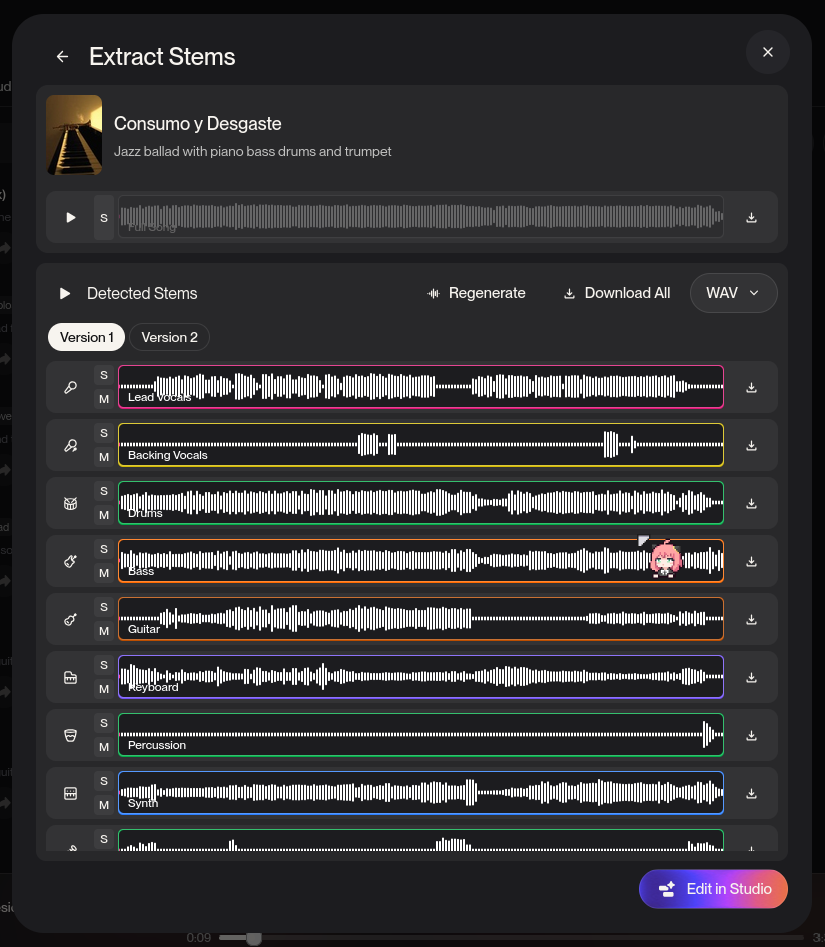
Once we have a demo we can start recording our song. In addition to our own performance, a music generation service like Suno can be used to generate production-sound accompanying tracks, effectively making AI act like our session band. Suno allows generating separate Stems that can be imported directly to Reaper.
Kiro creating tracks via spec-driven MCP
Once importing these tracks, Kiro can be used to automate setting proper gain levels in a single instruction by saying something like: “Reduce tracks 4-11 by -12db and color all tracks differently”
The final step is to put everything together and add FX chains to make the project sound as desired. This is where Kiro’s spec-driven development approach comes in handy, as it allows to plan and review all the relevant processing. The workflow described above is shown in the following video:
The final step is to put everything together and add FX chains to make the project sound as desired. This is where Kiro’s spec-driven development approach comes in handy, as it allows to plan and review all the relevant processing.
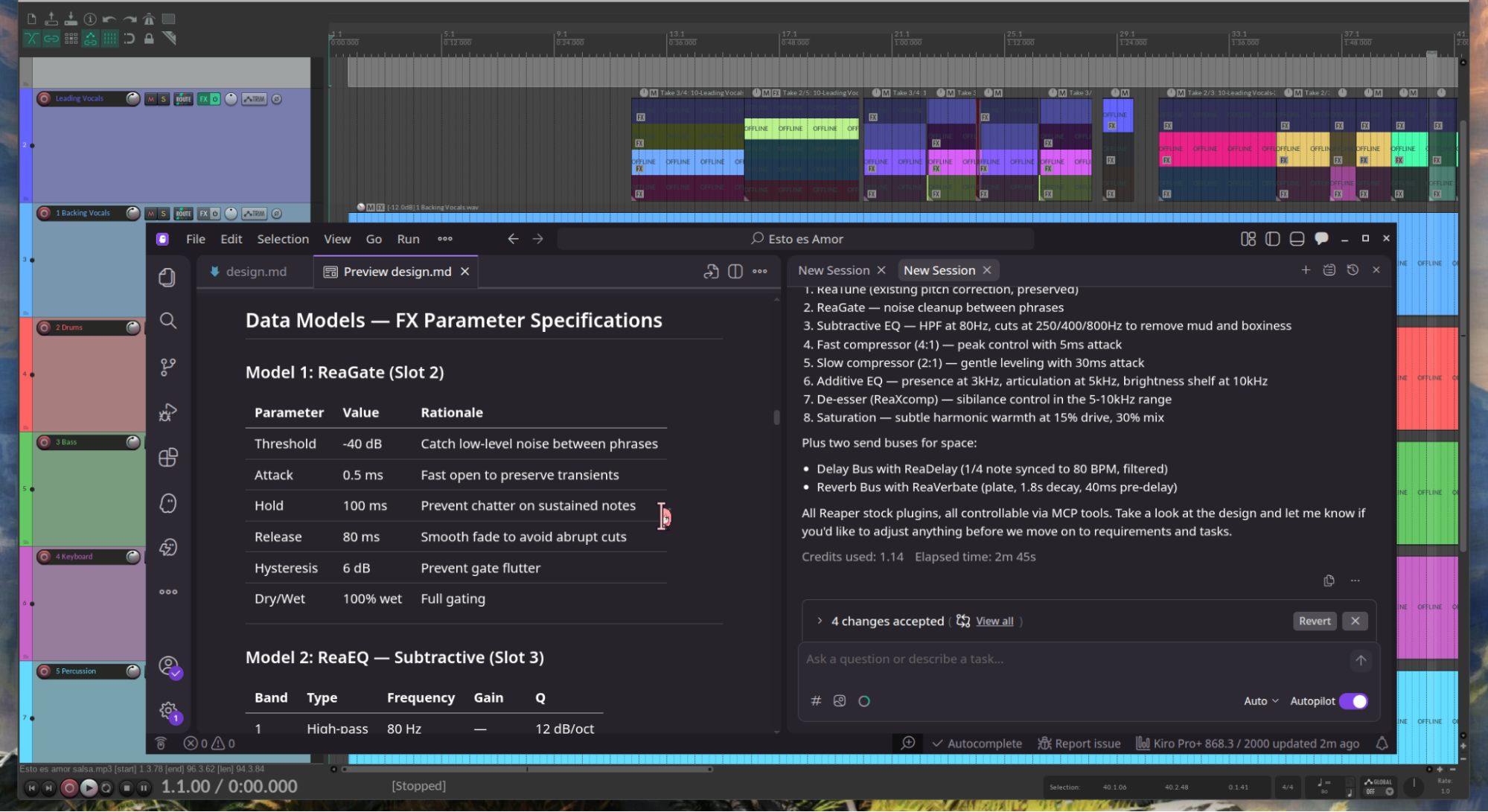
Kiro creating a design document detailing the proposed processing for vocals track which can be reviewed by the producer.
Kiro’s integrated tasks manager can then be leveraged to automatically run all the proposed tasks upon review.
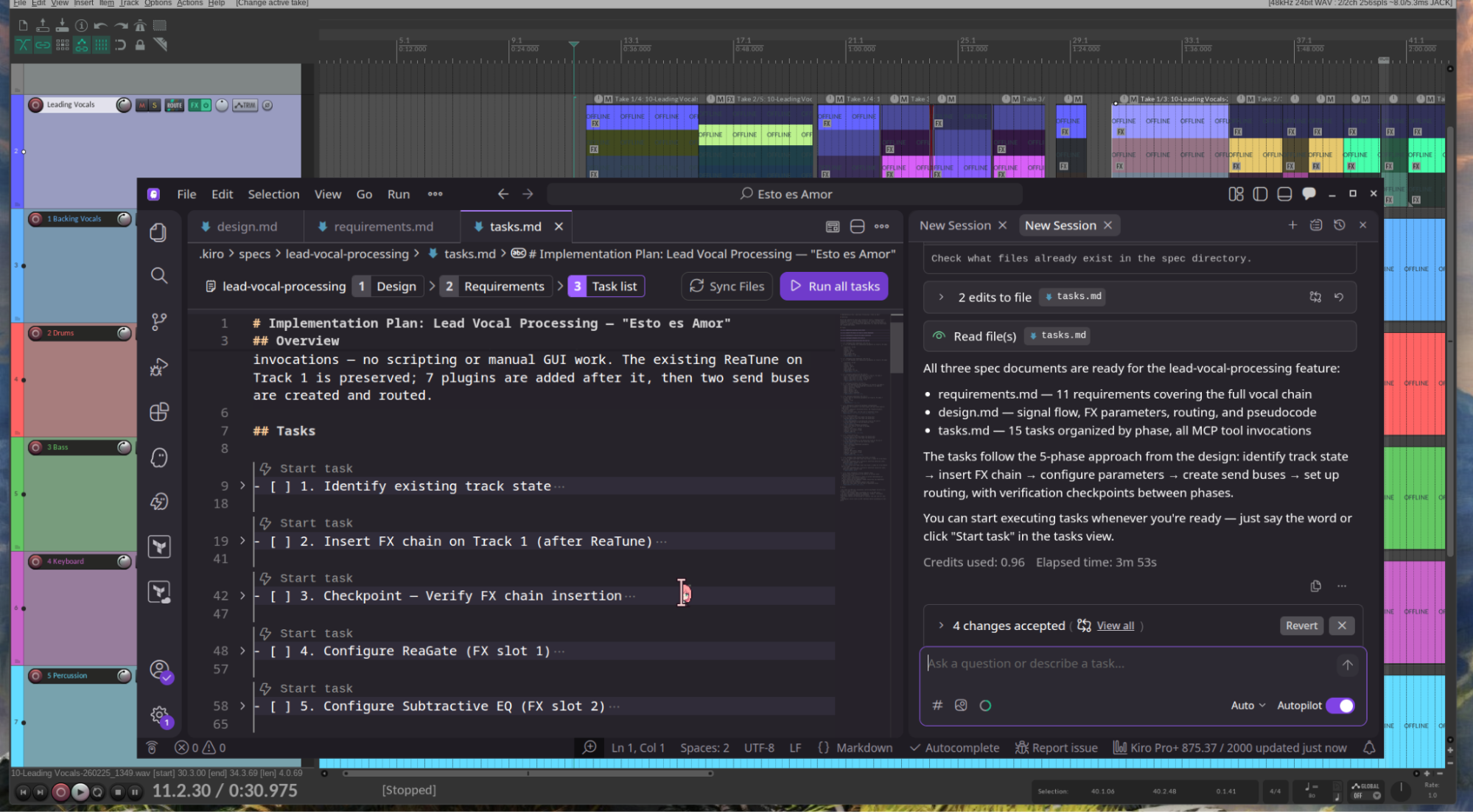
Kiro showing the list of tasks for processing vocals.
You steer, agentic tools lift
With spec-driven AI, humans define vision through detailed specifications while agentic tools like Kiro execute precisely via MCP, eliminating grunt work across any domain.
That’s the promise: not AI replacing artists (or engineers), but handling scaffolding so you focus on what matters. The same workflow powers track production, software deployments, or business operations. You steer, agentic tools lift.
If you’re curious how spec-driven AI could work for your team, we’d love to show you. Reach out to AgilityFeat.