
The FarmGAP application was a promising AI-built proof of concept that had not yet been put into use. Before the platform could move toward launch, SG Farm Services needed a technical audit to assess the codebase, surface security and maintainability risks, and define a realistic path to beta readiness.
AgilityFeat’s nearshore team conducted a two-week sprint to evaluate the platform’s architecture, security posture, and production readiness. The audit combined automated analysis, senior engineering review, QA walkthroughs, and UX input to prioritize fixes and shape a practical plan forward.
“AgilityFeat stepped in at a critical moment when I needed to quickly understand the state of FarmGAP. Their technical audit brought immediate clarity: a prioritized breakdown of issues and a clear, actionable path forward. In a matter of weeks, I went from uncertainty to making confident product decisions. Having a team that could move fast and bring that level of insight was invaluable.” Stasia Greenewalt, Business Owner
We were pleased to continue working with the client after the technical audit. A follow-up case study will cover the Phase 2 stabilization effort and the Phase 3 beta testing phase.
The Product
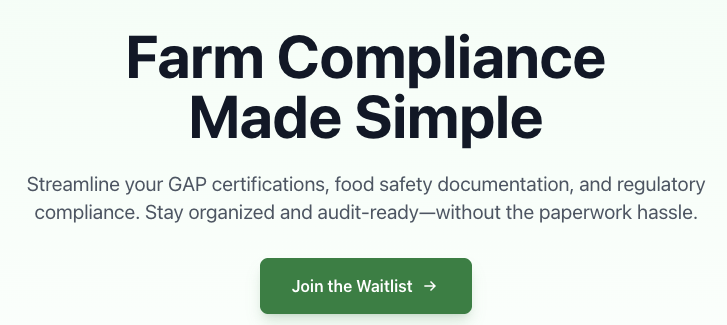
FarmGAP is a web-based app designed to help small and mid-sized farms complete and organize GAP and Produce Safety Rule compliance record keeping, both online and offline. The goal is to make food safety documentation simple and mobile-friendly for users who may not be highly technical but still need to meet strict audit requirements.
While this case study focuses on FarmGAP, the technical audit approach applies to any product that has moved quickly from concept to prototype. Whether a platform is an AI-built POC, an early MVP, or a more established application, a technical audit helps clarify what is working, what is risky, and what needs to happen before the product can scale or go into broader use.
The Challenge
The client was taking full advantage of the platform after the original developer and partner were no longer consistently available, and all had been built without any final user validation . Because much of the system had been built with AI assistance, the team needed a practical assessment of whether the product should be stabilized, refactored, or rebuilt.
This made the engagement especially important. A POC that looks functional on the surface can still hide architectural risk, security gaps, and maintenance issues that become expensive later. The goal was to identify those issues before the product entered active use.
Why a technical audit was the right move
A technical audit was the fastest way to reduce uncertainty. Instead of guessing at the platform’s readiness, AgilityFeat assessed the codebase, user flows, and production risks to create an evidence-based plan.
For an early-stage AI-built POC, that matters. The product may be real, but it still needs validation across architecture, security, QA, and UX before it can move confidently toward beta.
AgilityFeat’s Approach
AgilityFeat used a layered audit process to evaluate the platform from multiple angles.
- An AI agent reviewed the code architecture, security, and best practices and generated a preliminary findings report.
- A senior software engineer reviewed the findings and the code, then prioritized issues, added new issues missed by the AI Agent and estimated fixes.
- A QA engineer manually walked through the platform to identify functional problems.
- A UX expert reviewed user flows and guided the transition from POC to POV by structuring beta and user testing to validate real user value and inform the product roadmap and the go-to-market strategy.
This approach balanced speed with judgment. AI helped surface patterns quickly, while senior technical review ensured the findings were prioritized correctly and translated into action.
Technical Audit Findings
The audit surfaced a mix of small bugs, security issues, missing features, and small-to-medium refactors. Like many AI-built POCs, the platform had momentum, but was not ready for broader use.
Rather than treating every issue the same, we organized the findings into a practical sequence:
- Fix security concerns first.
- Resolve functional bugs and user flow issues next.
- Tackle refactors that would improve maintainability.
- Plan missing features for later phases.
We also ran a prioritization workshop, analyzed the user flow, and estimated the development work required to get the platform into better shape.
Tech Stack and Architecture
FarmGAP is a web-based, mobile-first PWA built with React and TypeScript, backed by Supabase (Postgres, authentication, row-level security, and Edge Functions) and deployed via Netlify in a monorepo architecture.
That stack is well suited for a lightweight, modern product, but it also demands careful implementation. For a compliance-focused platform, secure data handling and clean architecture are essential, especially before public launch.
From POC to Beta Product
One of the most useful outcomes of the engagement was a clear phase plan:
- 2 weeks to improve and stabilize the code.
- 2 weeks of beta testing.
- 3 weeks to incorporate feedback.
That sequence helped reposition FarmGAP from an AI-built POC into a stable beta candidate. It also created a concrete way to validate product value before committing to a larger expansion.
Technical Audit Results
By the end of the audit, the client had:
- Simple security fixes.
- A clear roadmap.
- A beta testing plan.
The bigger result was confidence. Instead of launching blindly, SG Farm Services now had a structured view of what needed attention and how to move forward safely.
Why AgilityFeat
AgilityFeat’s nearshore development model supported fast iteration, tight feedback loops, and close collaboration during this short, cost-effective engagement. That made it easier to move from findings to prioritization to a practical stabilization plan without losing time.
What this project shows
FarmGAP is a strong example of why a technical audit is valuable for an AI-built POC. AI can help accelerate early development, but a careful audit is what turns a prototype into something that can actually support beta testing and future growth.
For founders, the lesson is clear: speed gets you to a demo, but a technical audit gets you to a product you can trust.
We’ll share more soon on Phase 2 stabilization and Phase 3 beta testing as the product continues to evolve!
Ready to assess your own AI-built POC or early MVP? Talk to our team about a technical audit to assess what it needs before launch.
Further Reading:
- 2 Week Hybrid AI POC: Prototyping a Startup Concept with Smart Integrations and the Right Use of AI
- AI Video Editor Development: Building Verbolo’s Intelligent Content Creation Platform
- Introducing Builder Pods: AI-Native Squads Ready to Build
- Proof of Value vs. Proof of Concept in the Age of AI
- Best Practices for AI-Assisted Software Development