
AI can generate code quickly, but speed alone does not produce reliable software. Generating thousands of lines of code in seconds is counterproductive if it compromises structural integrity, security, and overall quality. Fast technical debt is still technical debt.
As I explained in my post on Best Practices for AI-Assisted Software Development, production teams need a structured approach that values architectural alignment and quality as much as raw speed.
This tutorial shows why vibe coding falls short for production software and how spec-driven development helps teams use AI to write production-ready code.
Why Vibe Coding Falls Short for Production Software
Vibe coding involves prompting an AI in a conversational and ad-hoc manner, generating code based on a general feeling or a loosely defined idea.
It definitely has its place. Vibe coding is a fantastic approach for rapid prototyping, writing simple automation scripts, or spinning up a quick MVP over a weekend.
But when applied to the real world of enterprise software, the illusion quickly breaks. Vibe coding lacks the rigorous foundation required to navigate complex, existing codebases or manage intricate dependencies. You can’t use the Force when dealing with mission-critical architecture. You need a precise blueprint. Without one, AI will struggle to produce reliable, production-ready outputs, often leading to regressions and unpredictable behavior.
What Is Spec-Driven Software Development?
SDD is a good alternative to move beyond the limitations of ad-hoc prompting. It is a framework designed specifically for navigating complex requirements alongside AI agents.
At its core, SDD works by defining specifications (or “specs”) first. These specs become the absolute source of truth for the desired features and functionality. While the exact format of a spec varies depending on the tool you use, it is essentially natural language documentation that clearly defines the requirements, system design, and the exact tasks required to implement a given feature.
In this new workflow, the spec acts as a binding, shared contract between the human and the machine, setting clear boundaries and expectations. The AI Coding Agent takes the defined spec and executes the coding tasks step-by-step.
Are we developers doomed to be replaced by AI agents executing specs? Not at all. In spec-driven development, the human developer’s role does not disappear. It evolves. The human doesn’t just watch the code compile. They guide the process. The developer reviews, vets, and iterates on the specs, ensuring the AI’s output adheres to the highest quality standards. Software developers are no longer just typists of syntax; they are elevated to integrators, reviewers, and systems architects.
Benefits of Spec-Driven Development
Adopting an SDD framework brings a cascade of powerful advantages to a development team, including:
- Free Documentation. Because you write the spec before the code is generated, the feature is automatically and comprehensively documented by default.
- Memory Banks for AI. Specs serve as permanent context (essentially memory banks) for AI agents. This prevents the AI from losing the plot or forgetting crucial constraints during long, complex projects.
- Focusing on the “What”: SDD frees development teams from getting bogged down in syntax. By letting the AI handle the “how,” developers can focus their cognitive energy entirely on solving business logic and addressing user needs (the “what”).
Challenges of Spec-Driven Development (and How to Overcome Them)
As with any approach, SDD comes with challenges. Here are the main ones, and how to overcome them.
The Waterfall Trap and Specification Drift
Demanding an exhaustive, “airtight” specification before any code is written repeats one of the core flaws of traditional waterfall development: implementation is inherently a discovery process.
Teams should treat the initial specification as a living hypothesis rather than a rigid gate. The spec, implementation, and verification should evolve in parallel as discoveries are made.
AI Non-Determinism, Hallucinations, and Context Limits
Because AI coding agents are non-deterministic and do not retain context across sessions, codebases are susceptible to feature sprawl and architectural drift.
This can be addressed through strong context engineering and rigorous scoping. Create one spec per bounded concern, and explicitly define both the acceptance criteria and the out-of-scope boundaries.
Loss of Control, Explainability, and Quality Assurance
As AI systems handle more of the code generation, developers risk losing a granular understanding of how the code works.
To overcome this, developers need to stay actively engaged in the co-creative process and accept full responsibility for the quality and safety of the output. A good rule of thumb is to only merge code they are comfortable being credited for.
Tutorial: Using Spec-Driven Development to Build a Note-Taking App with Kiro IDE
To see SDD in action, we can look at Kiro IDE. Kiro is an environment explicitly tailored for Spec-Driven Development. It generates specs composed of three main files:
requirements.mdoutlines the requirements in the shape of user stories following the Easy Approach to Requirements Syntax (EARS)design.mddetails the technical implementation to comply with requirementstasks.mdlist the tasks to be performed by AI sub-agent to implement the spec requirements
You can explore a practical demonstration of this workflow in the spec-driven-development-demo repository.
Step 1: Create the Requirements Spec
“Let’s build a simple web based note taking application with no user authentication. The user opens the app and starts adding and managing notes.” The main difference from vibe coding is that at this point, the result from this prompt will not be code. It is a detailed specification that describes the desired functionality in depth, covering requirements, implementation and even edge cases.
Kiro crafts the requirements file and writes them using the EARS syntax.
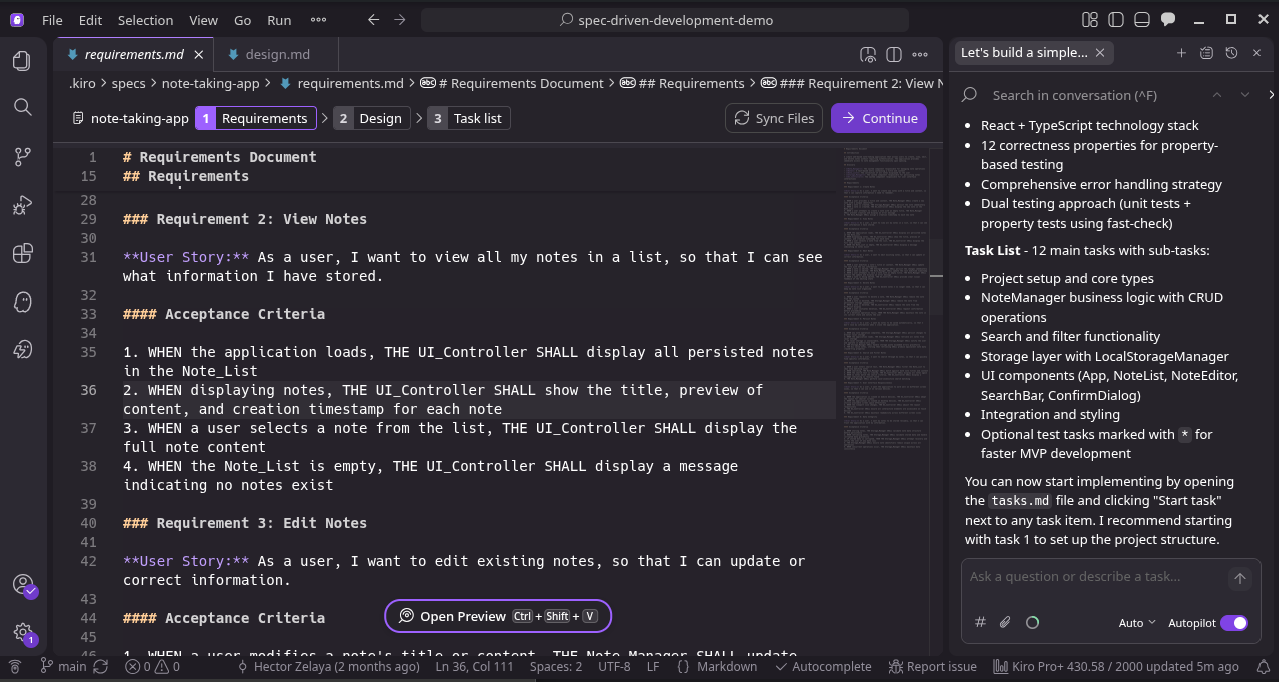
Step 2: Create the Design Contract
Once the developer is happy with the requirements, they prompt Kiro to move to the design phase, where it generates a design contract that describes the technical implementation for the defined requirements. The resulting document covers from architecture, tech stack, components, models and interfaces, to correctness properties and testing strategy for the spec.
This is the most critical step. If the design is wrong, the code will be wrong. In SDD, we debug the design, not the implementation. This file becomes the rigid contract for the AI agent.
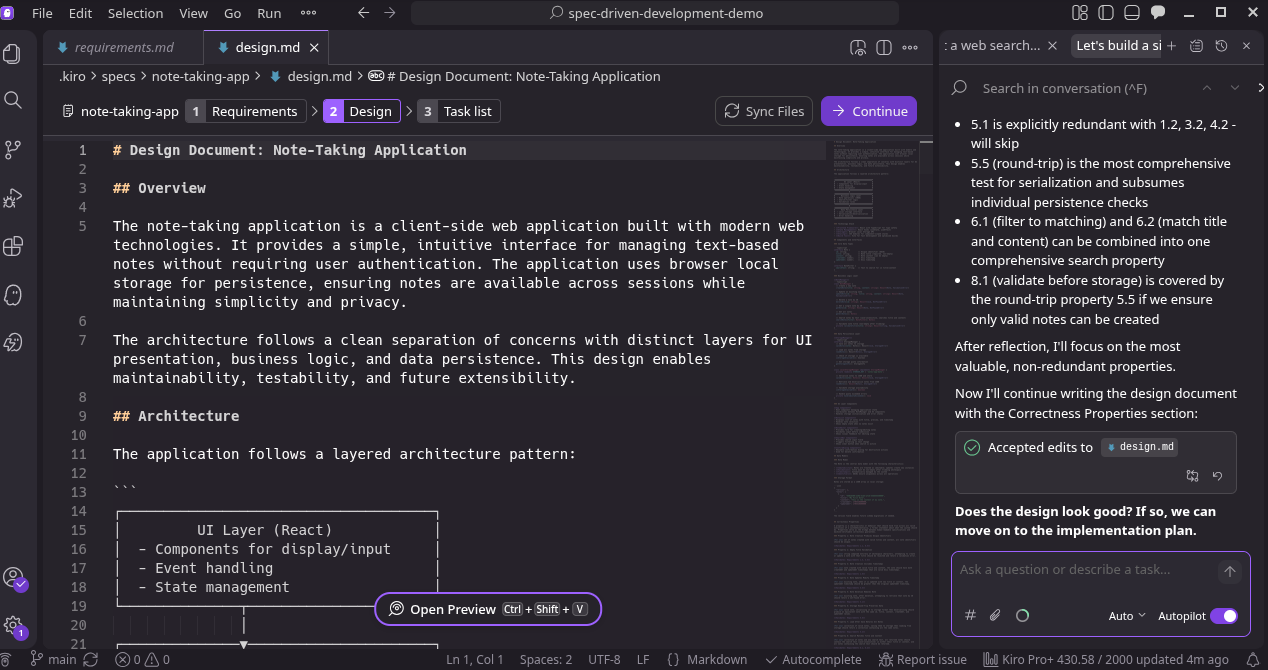
Kiro IDE window showing the design.md document and the chat panel.
Step 3: Generate the Implementation Tasks
Finally, after the design has been carefully reviewed, Kiro transforms the implementation details into atomic, actionable tasks that the AI agent can perform in order to build the feature defined in the spec. Now we’re getting actual code based on the implementation details.
These tasks are managed from a tasks manager bundled into the IDE, allowing for step-by-step execution with human-in-the-loop review, or running all the tasks one after the other without human intervention.
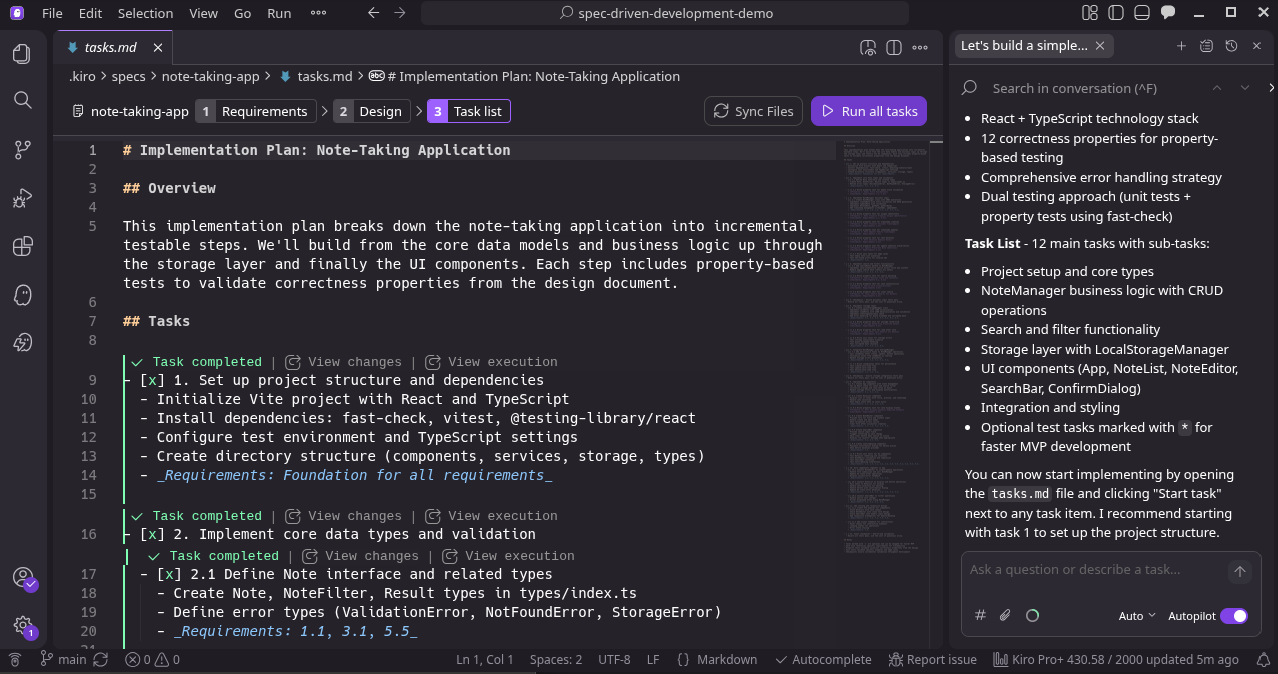
Kiro IDE window showing the task.md document with some tasks already completed.
Step 4: See the Completed Application
You now have a full working application written following the guidelines included in the initial specification created through Kiro IDE!
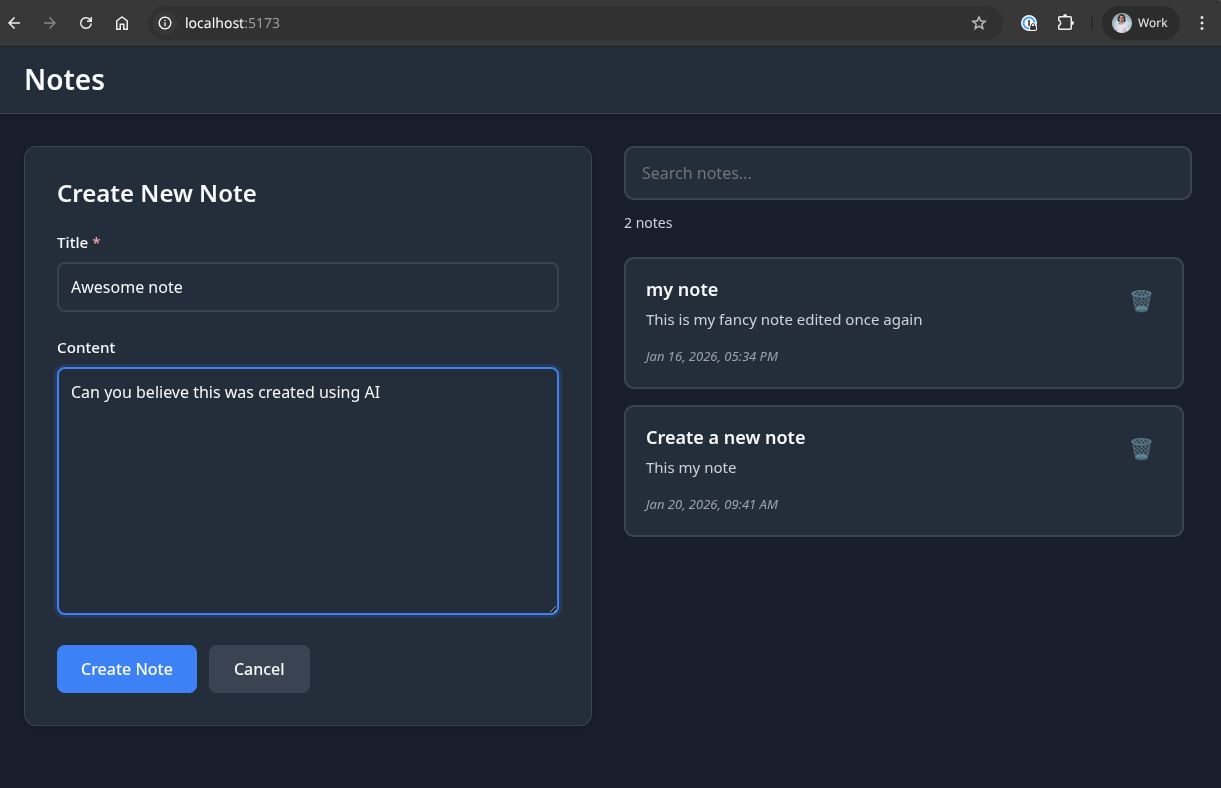
The Note-Taking App Built with Kiro IDE via SDD
Demo Time!
Writing Production-Ready Code with Spec-Driven Development
Spec-driven development helps teams use AI to produce reliable, production-grade software without sacrificing structure or quality.
AgilityFeat can help you take advantage of spec-driven development through AI-Native Builder Pods for short projects, full teams for secure, scalable AI implementations, and nearshore staff augmentation to extend your team with developers experienced in AI-assisted delivery.
Further Reading:
- Spec-Driven AI Integration: Automating Complex Workflows with MCP and Agentic Tools
- Best Practices for AI-Assisted Software Development
- What I Learned Using Spec Kits for AI Code Generation at Scale
- Introducing Builder Pods: AI-Native Squads Ready to Build
- AI Engineering Isn’t Just a Silicon Valley Story